
Thursday, November 11, 2010


Happy Veteran's Day!
Wishing everyone a Happy Veteran's Day. May we always remember those who served and gave that we might have the liberty that we as Americans expect as rights.

http://www.foundingfathers.info/stories/gadsden.html
by Chris Whitten, July 5, 2001, updated September 2002
Three years later, in 1754, he used a snake to illustrate another point. This time not so humorous.
Franklin sketched, carved, and published the first known political cartoon in an American newspaper. It was the image of a snake cut into eight sections. The sections represented the individual colonies and the curves of the snake suggested the coastline. New England was combined into one section as the head of the snake. South Carolina was at the tail. Beneath the snake were the ominous words "Join, or Die."
This had nothing to do with independence from Britain. It was a plea for unity in defending the colonies during the French and Indian War. It played off a common superstition of the time: a snake that had been cut into pieces could come back to life if you joined the sections together before sunset.
The snake illustration was reprinted throughout the colonies. Dozens of newspapers from Massachusetts to South Carolina ran Franklin's sketch or some variation of it. For example, the Boston Gazette recreated the snake with the words "Unite and Conquer" coming from its mouth.
I suppose the newspaper editors were hungry for graphic material, this being America's first political cartoon. Whatever the reason, Franklin's snake wiggled its way into American culture as an early symbol of a shared national identity.
In 1765 the common enemy was the Stamp Act. The British decided that they needed more control over the colonies, and more importantly, they needed more money from the colonies. The Crown was loaded with debt from the French and Indian War.
Why shouldn't the Americans -- "children planted by our care, nourished by our indulgence," as Charles Townshend of the House of Commons put it -- pay off England's debt?
Colonel Isaac Barre, who had fought in the French and Indian War, responded that the colonies hadn't been planted by the care of the British government, they'd been established by people fleeing it. And the British government hadn't nourished the colonies, they'd flourished despite what the British government did and didn't do.
In this speech, Barre referred to the colonists as "sons of liberty."
In the following months and years, as we know, the Sons of Liberty became increasingly resentful of English interference. And as the tides of American public opinion moved closer and closer to rebellion, Franklin's disjointed snake continued to be used as symbol of American unity, and American independence. For example, in 1774 Paul Revere added it to the masthead of The Massachusetts Spy and showed the snake fighting a British dragon.
By 1775, the snake symbol wasn't just being printed in newspapers. It was appearing all over the colonies ... on uniform buttons ... on paper money ... and of course, on banners and flags.
The snake symbol morphed quite a bit during its rapid, widespread adoption. It wasn't cut up into pieces anymore. And it was usually shown as an American timber rattlesnake, not a generic serpent.
We don't know for certain where, when, or by whom the familiar coiled rattlesnake was first used with the warning "Don't Tread on Me."
We do know when it first entered the history books.
In the fall of 1775, the British were occupying Boston and the young Continental Army was holed up in Cambridge, woefully short on arms and ammunition. At the Battle of Bunker Hill, Washington's troops had been so low on gunpowder that they were ordered "not to fire until you see the whites of their eyes."
In October, a merchant ship called The Black Prince returned to Philadelphia from a voyage to England. On board were private letters to the Second Continental Congress that informed them that the British government was sending two ships to America loaded with arms and gunpowder for the British troops.
Congress decided that General Washington needed those arms more than General Howe. A plan was hatched to capture the British cargo ships. They authorized the creation of a Continental Navy, starting with four ships. The frigate that carried the information from England, the Black Prince, was one of the four. It was purchased, converted to a man-of-war, and renamed the Alfred.
To accompany the Navy on their first mission, Congress also authorized the mustering of five companies of Marines. The Alfred and its sailors and marines went on to achieve some of the most notable victories of the American Revolution. But that's not the story we're interested in here.
What's particularly interesting for us is that some of the Marines that enlisted that month in Philadelphia were carrying drums painted yellow, emblazoned with a fierce rattlesnake, coiled and ready to strike, with thirteen rattles, and sporting the motto "Don't Tread on Me."
In December 1775, "An American Guesser" anonymously wrote to the Pennsylvania Journal:
First, it occurred to him that "the Rattle-Snake is found in no other quarter of the world besides America."
The rattlesnake also has sharp eyes, and "may therefore be esteemed an emblem of vigilance." Furthermore,
http://www.foundingfathers.info/stories/gadsden.html
by Chris Whitten, July 5, 2001, updated September 2002
Don't Tread on Me
American unity
Benjamin Franklin is famous for his sense of humor. In 1751, he wrote a satirical commentary in his Pennsylvania Gazette suggesting that as a way to thank the Brits for their policy of sending convicted felons to America, American colonists should send rattlesnakes to England.Three years later, in 1754, he used a snake to illustrate another point. This time not so humorous.
Franklin sketched, carved, and published the first known political cartoon in an American newspaper. It was the image of a snake cut into eight sections. The sections represented the individual colonies and the curves of the snake suggested the coastline. New England was combined into one section as the head of the snake. South Carolina was at the tail. Beneath the snake were the ominous words "Join, or Die."
 [Benjamin Franklin's woodcut from May 9, 1754. Newspaper Serial and Government Publications Division, Library of Congress.] |
The snake illustration was reprinted throughout the colonies. Dozens of newspapers from Massachusetts to South Carolina ran Franklin's sketch or some variation of it. For example, the Boston Gazette recreated the snake with the words "Unite and Conquer" coming from its mouth.
I suppose the newspaper editors were hungry for graphic material, this being America's first political cartoon. Whatever the reason, Franklin's snake wiggled its way into American culture as an early symbol of a shared national identity.
American independence
The snake symbol came in handy ten years later, when Americans were again uniting against a common enemy.In 1765 the common enemy was the Stamp Act. The British decided that they needed more control over the colonies, and more importantly, they needed more money from the colonies. The Crown was loaded with debt from the French and Indian War.
Why shouldn't the Americans -- "children planted by our care, nourished by our indulgence," as Charles Townshend of the House of Commons put it -- pay off England's debt?
Colonel Isaac Barre, who had fought in the French and Indian War, responded that the colonies hadn't been planted by the care of the British government, they'd been established by people fleeing it. And the British government hadn't nourished the colonies, they'd flourished despite what the British government did and didn't do.
In this speech, Barre referred to the colonists as "sons of liberty."
In the following months and years, as we know, the Sons of Liberty became increasingly resentful of English interference. And as the tides of American public opinion moved closer and closer to rebellion, Franklin's disjointed snake continued to be used as symbol of American unity, and American independence. For example, in 1774 Paul Revere added it to the masthead of The Massachusetts Spy and showed the snake fighting a British dragon.
 [Paul Revere's modified "Join or Die" snake from the masthead of Thomas's Boston Journal, July 7, 1774. Newspaper Serial and Government Publications Division, Library of Congress.] |
The birth of the U.S. Navy and the U.S. Marine Corps
 [The seal from a 1778 $20 bill from Georgia. The financial backing for these bills was property seized from loyalists. The motto reads "Nemo me impune lacesset," i.e. "No one will provoke me with impunity."] |
The snake symbol morphed quite a bit during its rapid, widespread adoption. It wasn't cut up into pieces anymore. And it was usually shown as an American timber rattlesnake, not a generic serpent.
We don't know for certain where, when, or by whom the familiar coiled rattlesnake was first used with the warning "Don't Tread on Me."
We do know when it first entered the history books.
In the fall of 1775, the British were occupying Boston and the young Continental Army was holed up in Cambridge, woefully short on arms and ammunition. At the Battle of Bunker Hill, Washington's troops had been so low on gunpowder that they were ordered "not to fire until you see the whites of their eyes."
In October, a merchant ship called The Black Prince returned to Philadelphia from a voyage to England. On board were private letters to the Second Continental Congress that informed them that the British government was sending two ships to America loaded with arms and gunpowder for the British troops.
Congress decided that General Washington needed those arms more than General Howe. A plan was hatched to capture the British cargo ships. They authorized the creation of a Continental Navy, starting with four ships. The frigate that carried the information from England, the Black Prince, was one of the four. It was purchased, converted to a man-of-war, and renamed the Alfred.
To accompany the Navy on their first mission, Congress also authorized the mustering of five companies of Marines. The Alfred and its sailors and marines went on to achieve some of the most notable victories of the American Revolution. But that's not the story we're interested in here.
What's particularly interesting for us is that some of the Marines that enlisted that month in Philadelphia were carrying drums painted yellow, emblazoned with a fierce rattlesnake, coiled and ready to strike, with thirteen rattles, and sporting the motto "Don't Tread on Me."
Benjamin Franklin diverts an idle hour
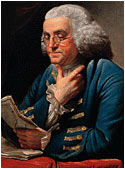 [Benjamin Franklin, portrait by David Martin, 1767. White House Historical Association.] |
"I observed on one of the drums belonging to the marines now raising, there was painted a Rattle-Snake, with this modest motto under it, 'Don't tread on me.' As I know it is the custom to have some device on the arms of every country, I supposed this may have been intended for the arms of America."This anonymous writer, having "nothing to do with public affairs" and "in order to divert an idle hour," speculated on why a snake might be chosen as a symbol for America.
First, it occurred to him that "the Rattle-Snake is found in no other quarter of the world besides America."
The rattlesnake also has sharp eyes, and "may therefore be esteemed an emblem of vigilance." Furthermore,
"She never begins an attack, nor, when once engaged, ever surrenders: She is therefore an emblem of magnanimity and true courage. ... she never wounds 'till she has generously given notice, even to her enemy, and cautioned him against the danger of treading on her."Finally,
"I confess I was wholly at a loss what to make of the rattles, 'till I went back and counted them and found them just thirteen, exactly the number of the Colonies united in America; and I recollected too that this was the only part of the Snake which increased in numbers. ...
"'Tis curious and amazing to observe how distinct and independent of each other the rattles of this animal are, and yet how firmly they are united together, so as never to be separated but by breaking them to pieces. One of those rattles singly, is incapable of producing sound, but the ringing of thirteen together, is sufficient to alarm the boldest man living."Many scholars now agree that this "American Guesser" was Benjamin Franklin.
Wednesday, November 10, 2010
What week is it?
We have our curriculum split up into six week packs with the first five weeks being the core learning and the last week being a review and prep for the next six weeks.....To keep us on track we put fish in the fish bowl for each week we are working on and then on the sixth week we take them back down again... the boys love it.

Classroom Motivations
Once upon a time when Jacob went to the regular public school up the road, he was given a clip on a chart where they would track when a child would have discipline problems
I have decided that it might be more helpful to do the opposite and not focus so much on the "don't" and focus more on the "do" and reinforce good behavior
I use to use just a yard stick that was painted with clips, but found a chart and have repurposed it as my "We are all good apples" chart.
So I have the apple tree and as my kids are found doing good things during the day, we put an apple on the tree....at the end of the week if our tree is full of apples, they can get a treat from the treasure box(a small piece of candy, a sticker, or some other small prize)
So far it has worked for us and created more opportunities to want to do good rather than just avoiding misbehavior.
We are all good apples!


I have decided that it might be more helpful to do the opposite and not focus so much on the "don't" and focus more on the "do" and reinforce good behavior
I use to use just a yard stick that was painted with clips, but found a chart and have repurposed it as my "We are all good apples" chart.
So I have the apple tree and as my kids are found doing good things during the day, we put an apple on the tree....at the end of the week if our tree is full of apples, they can get a treat from the treasure box(a small piece of candy, a sticker, or some other small prize)
So far it has worked for us and created more opportunities to want to do good rather than just avoiding misbehavior.
We are all good apples!
Tuesday, November 9, 2010


Monday, November 8, 2010
what's in the book bin this month?
Fall is here and winter is near......We are saying good by to all of our halloween books and to our books about starting school.
We have books about Christmas and Santa and winter and winter friends


and we will continue our books about fall and thanksgiving
*The boys were really sad to say goodbye to the book Froggy's Halloween, so I will have to say that was our book bin favorite from last month.
Want to follow along with us?
Our next unit for literature is the title The Snowy Day. We will be doing another lapbook and tons of fun winter activities.
We will be doing the lapbook from homeschool share.

Sorting the upper and lower case S.

fun math games await with these cards including adding, subtracting and counting.

We will learn sizes and 1st, 2nd, 3rd, first last, etc with these cards

You can find these card games and more from Confessions of a Homeschooler.
We will be doing the lapbook from homeschool share.
Sorting the upper and lower case S.
fun math games await with these cards including adding, subtracting and counting.
We will learn sizes and 1st, 2nd, 3rd, first last, etc with these cards
You can find these card games and more from Confessions of a Homeschooler.
Friday, November 5, 2010
Aesop's Fables Lapbook Pages
We have been learning about Aesop's Fables and how you can learn moral lessons through stories. We read several stories and did some really easy and fun lapbook pages from homeschool share.

Subscribe to:
Posts (Atom)